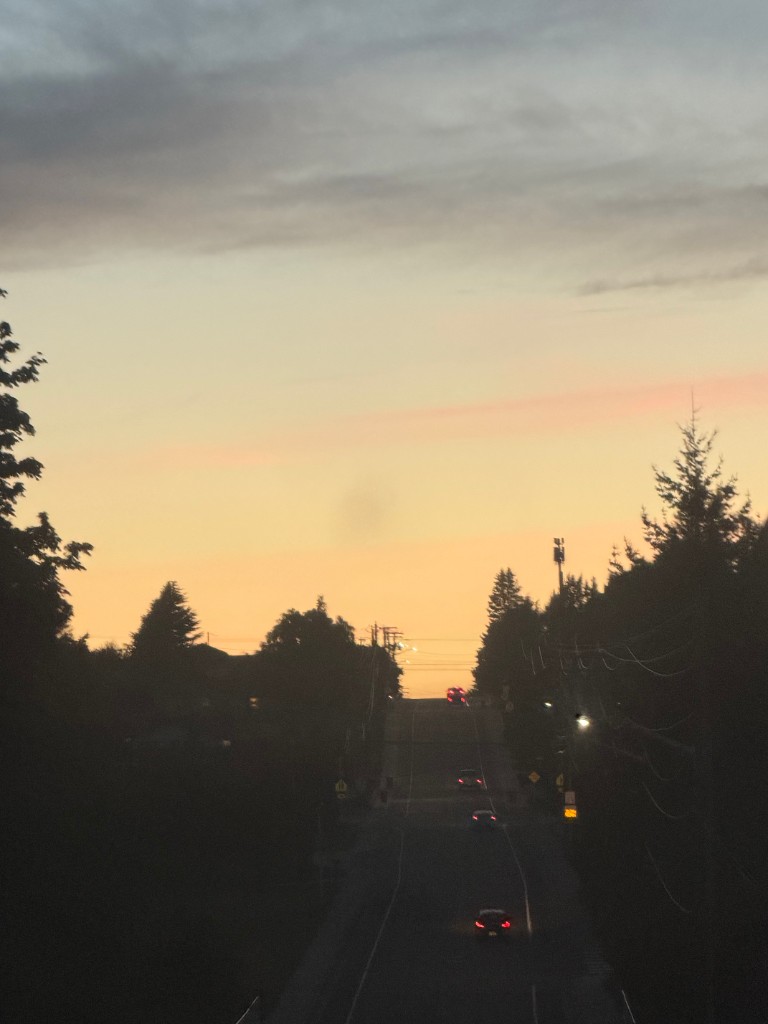
A reader sent this in. The place is real. The sounds are what they heard. We are not calling it proven fact.
A reader walking at night in Ferndale hears them on the move. Not a backyard chorus that stays put. This is a walk: the yips start off to one side, then they are ahead, then they are behind, then they are on the other side of the road as if the pack changed its mind about which field to use. It does not feel like animals that got left behind. It feels like something keeping the same pace. They stop. The noise stops, or it does not — it relocates. They start again. The next burst is farther along the route than it should be if the animals had stayed where they were.
Coyotes are real on the Ferndale flats. They use the Nooksack, the farm edges, the scraps of cover between subdivisions, the ditches that run toward Tennant Lake and Hovander. A small family can sound like a crowd. That is how the yip-howl works: one or two animals throw their voices around until a person counts eight. People who have never heard it think they are hearing a woman, or a child, or something that is not an animal. They are usually hearing coyotes. That does not explain a sound that stays with you when you turn a corner. A pack hunting the edge of town can move. A pack that seems to occupy both sides of the road at once is the part that will not sit still.
The reader says it followed. Not on the pavement. In the dark off the shoulder, in the grass, in the gap between houses where a flashlight would only make you look foolish. Left, then right, then behind, as if the fields were handing the walk off. They did not see eyes. They did not see a body. They heard a scream that did not sound like a dog, then the stacked yips, then quiet that was worse because the next call came from a direction that should have been empty. They kept walking because turning around would have meant walking back through the same dark they had just charged with a story.
What we do not know is how many animals were in that chorus, whether they were the same family the whole way, and whether anything in the sound was “wrong” beyond what coyotes already do when they work a territory. A yip-howl is built to confuse a count. Distance over flat ground is built to confuse a direction. Both can be true at once. Both can also be the cover a person uses when the noise will not stay in one pasture. The river is still a river. The flats still hold farms. Coyotes still hunt the edge of town. That is the ordinary explanation, and it is a good one, and it does not quite cover a walk that felt escorted.
Walk the public road if it is a public road. Do not cut through fields with a light and a theory. Do not shoot at a noise. If you hear a woman screaming in the grass after midnight, assume coyote first. Then decide whether you still want to finish the loop. The Ferndale walk does not need a grave to be a story. It needs a road, a night, and a sound that will not stay on one side of you.